L.A.B. Golf DF3 Putter Review – Lie Angle Balanced Stroke Stabilizer
Published October 23, 2026
Finding a putter that feels natural and stays square through impact is a lifelong quest for many golf ers. While traditional mallets rely on high MOI to resist twisting, some brands have taken a different approach by addressing the physics of the stroke itself. The DF3 from L A B Golf represents a refined take on this philosophy, aiming to eliminate the torque that typically forces a putter face to open or close during the swing.
Introduction to the L.A.B. Golf DF3
The DF3 is positioned as a stroke stabilizer rather than a traditional putter. The name L.A.B. stands for Directed Force, a nod to the company’s mission to create a putter that does not fight the golf er’s natural hand movements. While the original DF mallet gained a reputation for its massive footprint and distinct look, the DF3 serves as a sleeker, more compact version of that design. It retains the same core geometry but reduces the overall bulk, making it a more palatable option for those who found the original model too imposing on the greens.
The Tech Behind the L.A.B. Golf DF3
At the heart of this putter is the patented Lie Angle Balance technology. Most putters are designed with a center of gravity that creates torque, meaning the head naturally wants to rotate during the stroke. L.A.B. Golf claims to have solved this by creating a zero-torque design. When the putter is fitted to the golf er’s specific lie angle, the head is balanced so that it stays square to the target line without the golf er needing to manually manipulate the face.
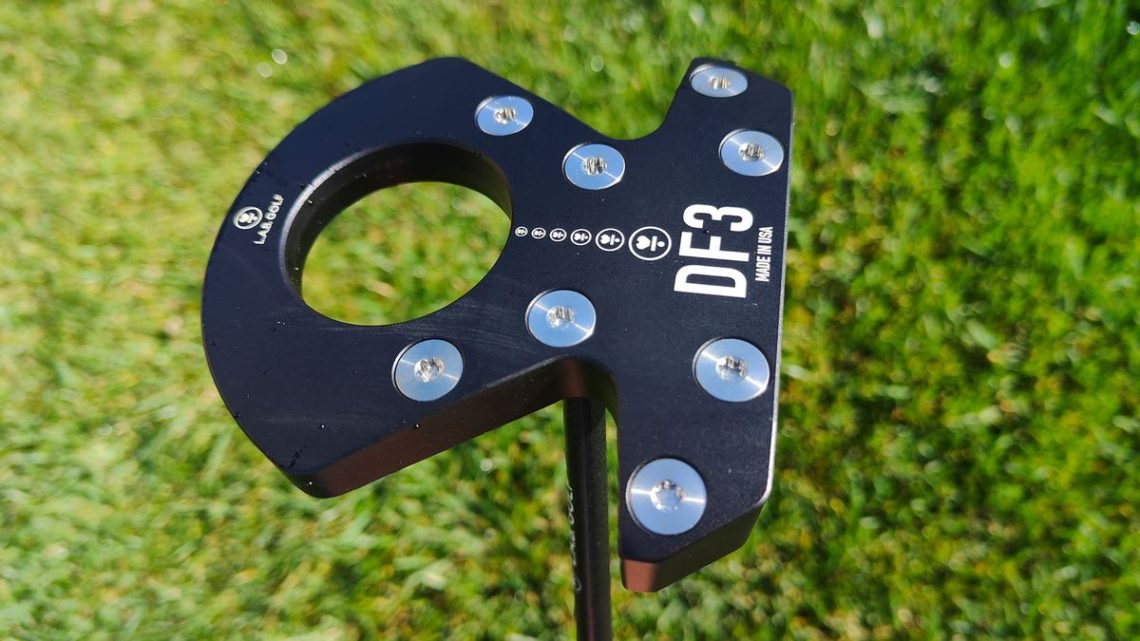
The DF3 is center-shafted and features a flat-bottom design. One of the most critical technical aspects of the head is the inclusion of eight individual sole weights. These weights are strategically positioned along the wings of the mallet to stabilize the head throughout the entire arc of the stroke. By distributing mass in this manner, the putter significantly reduces head twisting at impact, which is often the primary cause of missed putts.
On-Course Performance and Feel
In real-world testing, the stability of the DF3 is most evident on shorter putts. When playing rounds, the putter feels remarkably steady on strokes from inside 10 feet. Because the face resists twisting, there is less anxiety regarding whether the ball will be struck on the heel or the toe. The sensation is one of the face squaring up naturally, allowing the golf er to focus more on line and speed rather than the mechanics of the face angle.
Much of this consistency is tied to the fitting process. Because the zero-torque promise relies on the putter being used at the correct lie angle, an optimal fit is essential. When the lie angle matches the golf er’s natural posture, the putter feels like an extension of the arms, moving effortlessly along the intended path. This reduction in mechanical struggle can lead to a more confident stroke, especially under pressure.
Design Details and the Gimme Getter
Visually, the DF3 is a modern mallet with a unique construction. The shaft connects behind the front flange and feeds directly into a hollow ring. This design isn’t just for aesthetics; it contributes to the overall balance of the head. One of the most talked-about features is the Gimme Getter. This is a hollow center cutout shaped exactly like a golf ball. Instead of bending over to pick up a short putt, the golf er can simply press the putter onto the ball to scoop it up into the ring.
While the DF3 is sleeker than its predecessor, it is still a substantial piece of equipment. In perfectly manicured greens, the flat bottom glides smoothly. However, in slightly thicker grass or when putting from off the green, the bulkiness of the head can become a factor. Some golf ers may find that a more agile blade is preferable in rougher conditions where the larger footprint of the DF3 might catch the grass.
Customization and Fitting Options
Customization is a major pillar of the L A B Golf experience. The DF3 is not a one-size-fits-all product; it is designed to be tailored to the individual. Golf ers can choose from eight different colors and 33 different alignment-marking options to suit their visual preferences. Weighting is also adjustable, with standard, heavy, and light head weight options available to change the feel and swing weight of the club.
Beyond the head, the shaft and grip options are extensive. While many prefer the standard length, the DF3 is also available in counterbalanced, Arm Lock, and Broomstick versions to accommodate different putting styles and physical needs. Achieving this level of customization is a key part of Golf Alignment Mastery, as the equipment must work in harmony with the body’s alignment to the target. We could not verify specific local fitting availability or pricing for Oregon-based golf ers from the provided research, so those in the Pacific Northwest may need to coordinate directly with the manufacturer or a certified fitter.
Comparison: DF3 vs. Traditional Mallets
When compared to a traditional high-end mallet, such as the Ping PLD Anser 2, the differences in philosophy are clear. A traditional mallet like the Anser 2 is designed for agility and a classic feel, relying on a high moment of inertia to help with off-center hits. It feels more like a tool that the golf er controls. In contrast, the DF3 feels like a system that guides the golf er. The DF3 offers significantly more resistance to head-twisting, making it feel more stable on the target line.
The trade-off is primarily in the feel and agility. A traditional blade or small mallet feels more responsive and is easier to manipulate on breaking putts or in thick rough. The DF3 trades that agility for raw stability. For the golf er who struggles with a “yippy” stroke or a face that consistently leaves the ball left or right, the stability of the DF3 is a massive advantage. For the purist who likes to feel every nuance of the stroke, the zero-torque feel might seem too restrictive.
Pros, Cons, and Final Verdict
The L.A.B. Golf DF3 is a precision instrument that challenges the traditional way we think about putting. Its strengths lie in its build quality and its ability to keep the face square without manual effort. For many, this leads to an immediate increase in confidence on short-to-mid-range putts.
- Pros: Exceptional stability, reduced head twisting, highly customizable, and a helpful alignment system.
- Cons: Large head size may not appeal to all, and it can feel bulky in thick grass.
Ultimately, the DF3 is a specialized tool. It is best suited for the golf er who is tired of fighting their own stroke and wants a putter that removes the variable of face rotation. By simplifying the mechanical requirements of the stroke, it allows the player to focus on Course Management: Strategy to Lower Your Scores, treating the putt as a matter of distance control rather than a battle against physics. If you struggle with consistency and prefer a stable, substantial feel, the DF3 is a worthy investment in your short game.
Frequently Asked Questions
What is Lie Angle Balance technology?
It is a patented technology from L.A.B. Golf intended to create zero-torque putters that stay square through the stroke without requiring manual manipulation.
How does the DF3 differ from the original DF model?
The DF3 is a smaller and sleeker mallet than the original DF, though it retains the same general shape.
What is the Gimme Getter feature?
The Gimme Getter is a hollow center cutout shaped like a golf ball, allowing the golf er to scoop up the ball by pressing the putter onto it.
Does the L.A.B. Golf DF3 come in different shaft options?
Yes, it is available in standard-length, counterbalanced, Arm Lock, and Broomstick versions.
Sources
For more information, see: