
Golf Alignment Mastery: Train Your Eyes and Body
Published October 5, 2026
Golf Alignment Mastery involves training the eyes and body to set up square to the target to ensure a proper swing path. Using tools like the Tour Aim system helps remove ‘feel’ from the process, providing visual references for the clubface and body position. Consistent alignment reduces inconsistent contact and prevents common errors like over-the-top swings.
Many golfers spend hours on the range working on their swing plane, grip, and tempo, only to step onto the first tee and push the ball into the rough. The frustrating part is that the swing often feels identical to the one they practiced. The missing link is usually not the swing itself, but the setup. When you are aimed incorrectly, your brain recognizes the misalignment during the downswing and forces your body to compensate to reach the target. This leads to the dreaded slice or hook, even when your mechanics are technically sound.
The Invisible Culprit: Why Your Alignment Matters
Alignment is often called the invisible culprit because it is nearly impossible to judge accurately by feel alone. Most amateurs believe they are aimed straight when they are actually aimed several degrees off-target. This discrepancy creates a conflict between the eyes and the body. If your feet are aimed right of the target but your eyes are locked on the pin, your subconscious will likely pull the club across the line to compensate.
These mid-swing adjustments destroy consistency. Instead of a repeatable motion, you are performing a different “save” on every shot. Achieving Golf Alignment Mastery means removing the guesswork from the setup so that the swing can perform its job without interference. When your body and clubface are perfectly squared, the path of the club becomes predictable, and your ball flight stabilizes.
The Fundamentals of Golf Alignment Mastery
To square up correctly, you must understand the relationship between three distinct lines: the target line, the clubface, and the body line. The target line is the imaginary straight line from your ball to the intended target. The clubface is the first thing that should be set; it must be perpendicular to the target line. Once the face is square, the body line—consisting of the feet, hips, and shoulders—should be parallel to the target line, not pointing at the target.
A common mistake is aiming the shoulders directly at the target. Because your shoulders are behind the ball, aiming them at the target actually puts your body in an open position, which often leads to a pull or a hook. Proper alignment requires the shoulders to be parallel to the target line, similar to how railroad tracks run side-by-side but never meet.
Training Your Eyes with the Tour Aim System
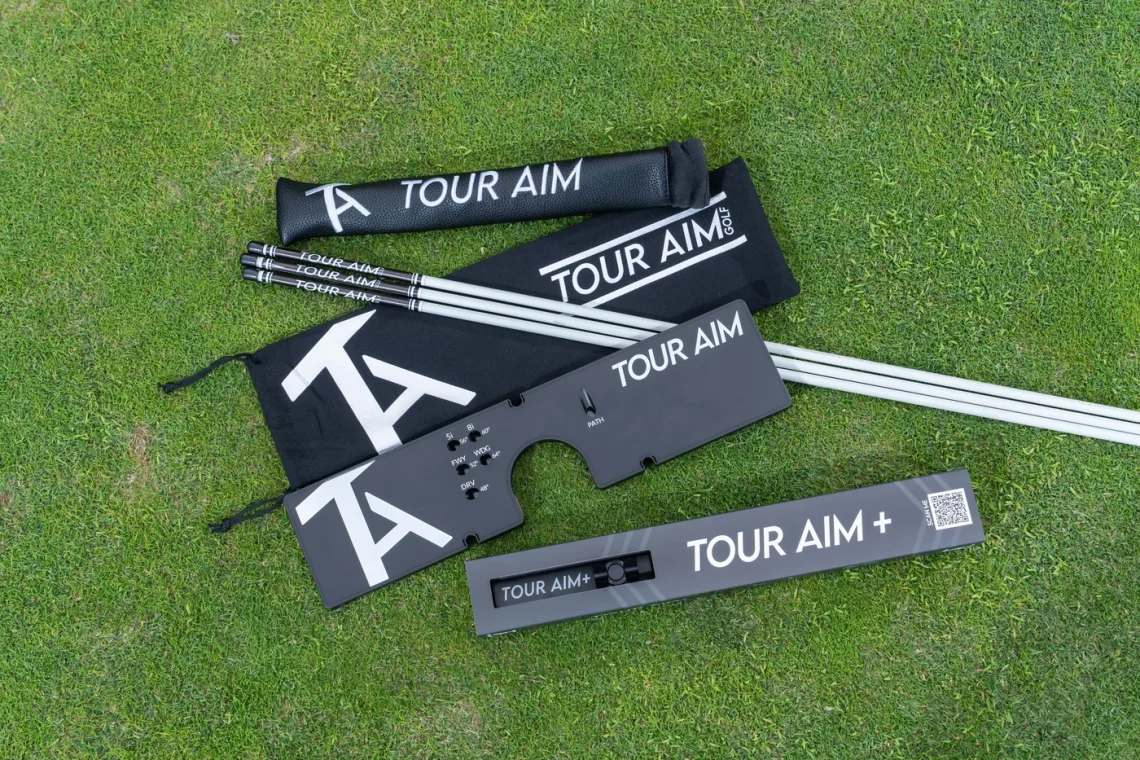
Because the human eye is easily deceived, professional-grade tools are necessary to recalibrate your visual perception. The Tour Aim 3.0 Pro Training System is designed for this purpose, utilizing a baseplate and premium alignment sticks to provide concrete physical references.
- The Alignment Setup: This configuration helps golfers consistently set up square to the target. By placing the sticks in a specific orientation, you can see exactly where your feet and shoulders sit in relation to the target line.
- Tour Aim+: This tool provides a visual square clubface reference at address. It removes the “feel” element of face alignment, ensuring the club is pointing exactly where it needs to before the swing begins.
- Adjustable Putting Gate: Precision starts with the start line. This gate allows you to test your putting path and setup, ensuring the ball starts on the correct line before the break takes over.
Correcting the Swing Path Through Alignment
Alignment does not just affect where the ball starts; it dictates the path the club takes through the impact zone. When you use alignment tools to fix your setup, you can then use specific setups to fix your path.
The Path Hole Setup places an alignment stick directly in the swing path. This creates a physical barrier that forces the club to travel in a specific way, providing immediate feedback to eliminate over-the-top moves and teaching the golfer how to shallow the club. Similarly, the On-Plane Takeaway setup uses sticks to provide feedback on the takeaway and downswing, which is essential for preventing the slice or hook patterns that plague many amateurs.
For those struggling with posture, the Swing Plane Setup is invaluable. It helps eliminate early extension—the tendency for the hips to move toward the ball during the downswing—by keeping the club in front of the body and maintaining a consistent spine angle.
Short Game Precision: Chipping and Putting
Alignment errors are magnified in the short game. A one-degree error on a 300-yard drive is a few yards off; a one-degree error on a 10-foot putt is a missed shot. The Chipping Setup uses a narrow alignment stick layout to train ball-first contact and a repeatable low point. This ensures that you are not hitting the ground behind the ball or thinning the shot over the green.
Consistency in the short game also depends on the equipment you use. For example, a putter with a consistent face and balanced weighting, such as the one discussed in our Odyssey White Hot OG Putter Review, works best when the start line is perfectly squared. Without alignment mastery, even the best putter in the world cannot compensate for a body that is aimed four feet right of the hole.
From the Range to the Course
The challenge for most golfers is transitioning from the “training wheels” of alignment sticks on the range to the open fairways of the course. To bridge this gap, start by using a single alignment stick on the course for your first few practice holes, then move to using an intermediate target. Pick a spot—a specific blade of grass or a pebble—about two feet in front of your ball that lies exactly on the line to your target. Square your clubface to that spot first, then align your body to the face.
Technology can also assist in target identification. Using a Garmin Approach S70 can help you identify the exact center of the fairway or the precise location of a hazard, giving you a more accurate target to align toward. When you know exactly where the target is, your alignment process becomes much more intentional.
Professional Guidance in Portland and Beyond
While tools and drills are helpful, there is no substitute for a professional eye. For golfers in the Pacific Northwest, the Balance Point Golf School in Portland, Oregon, provides a high level of specialized instruction. Master Teacher Jim Waldron conducts private custom golf instruction in Portland from June through October. His approach focuses on five key areas, including Mastering the Craft of Ballstriking and Mastering the Art of Scoring, both of which rely heavily on alignment mastery.
Lessons in Portland are conducted by appointment with a 1:1 or 1:2 teacher-to-student ratio to ensure personalized attention. For those who cannot visit Portland during the summer season, Jim Waldron is available year-round for remote, real-time webcam lessons via Zoom, Google Meet, or Facetime. This allows golfers regardless of their location to receive expert feedback on their full swing, putting, and mental game.
Alignment Mastery Checklist
Use this checklist during your next practice session to ensure you are training your eyes and body correctly:
- Target Identification: Have I picked a specific target and a corresponding intermediate spot two feet in front of the ball?
- Clubface Squaring: Is the clubface perpendicular to the target line before I move my feet?
- Body Alignment: Are my feet, hips, and shoulders parallel to the target line (like railroad tracks)?
- Path Verification: If using training tools, am I swinging through the path without hitting the alignment sticks?
- Consistency Check: Does the ball start on the intended line, or am I still compensating mid-swing?
Frequently Asked Questions
How does poor alignment affect the golf swing?
Poor alignment often leads to an improper swing path, which results in inconsistent ball direction and poor contact.
What is the purpose of the Tour Aim+ tool?
Tour Aim+ provides a visual square clubface reference at address, removing the need to rely on ‘feel’ for face alignment.
Can I get professional alignment instruction in Portland, Oregon?
Yes, Master Teacher Jim Waldron at Balance Point Golf School provides private custom instruction in Portland from June through October.
How does the Path Hole Setup help the swing?
It places an alignment stick in the path so the club has only one way through, helping golfers eliminate over-the-top swings and learn to shallow the club.
Sources
For more information, see: